Search: Site This Page
770-592-1001

| Ecovac Services / Technologies / |
Mobile Dual Phase Extraction EFR® Enhanced Fluid Recovery
EcoVac Services’ Enhanced Fluid Recovery (EFR®), a mobile version of dual phase / multi phase extraction, was invented and developed by co-founder David M. Goodrich, PG. In 1988, Mr. Goodrich was responsible for remediating Underground Storage Tank sites for Texaco and Atlantic Richfield Petroleum Companies in California and Nevada. Recognizing a need for a mobile, inexpensive remediation technology, he invented EFR® for environmental groundwater remediation.
EFR® removes multiple phases of hydrocarbons (liquid, dissolved, adsorbed and vapor phase) simultaneously by extracting fuel, vapors, and contaminated groundwater from multiple monitor or recovery wells. EFR® has also been highly successful in removing significant contamination from sites where other organic chemicals such as acetone or chlorinated solvents have been present in soil and groundwater.
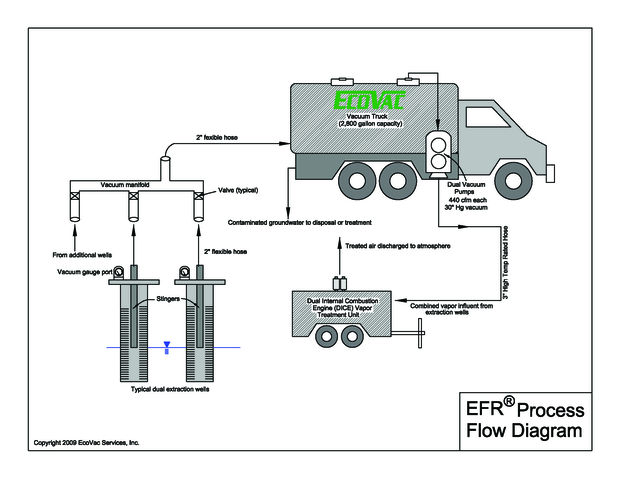
EcoVac’s EFR® technology employs a combination of a specially designed truck-mounted vacuum and liquid handling system integrated with a mobile hydrocarbon vapor treatment system (where required). High vacuum is applied to multiple monitor or recovery wells with down hole apparatuses to control the fluid elevation in each well. Therefore, the vacuum forcefully induces contaminant liquids and vapors to be simultaneously pulled into the extraction wells from the vadose zone, capillary fringe, and the saturated zone. Extracted contaminant liquids are collected in the mobile transport unit. Harmful volatile vapor emissions are treated by the integrated vapor destruction system if required.
The effectiveness of the EFR® process has been proven on thousands of UST sites, fuel terminals, refineries, airports, and military installations. EcoVac has conducted over 15,000 EFR® events at greater than 2,300 sites between 1995 and 2010. EcoVac Services has provided EFR® to over 450 consulting firms and individual clients in 42 states and Puerto Rico.
EcoVac’s pioneering efforts to develop and improve upon the EFR® technology have led co-founder Anick Athens to invent patented SURFAC® Surfactant Enhanced Aquifer Remediation, SOLV-IT® NAPL Remediation, and ISCO-EFR® technologies. These highly effective and proven technologies build on EFR® by combining its ability to control the liquid and vapor flow in the subsurface with the introduction of EcoVac Formulated Surfactants (EFS™), cosolvents or biosolvents, and activated chemical oxidants. This is the EcoVac “Combined Technology Approach”.
The Combined Technical Approach is a powerful tool as it allows a phased approach to whole site remediation. The EFR® technology provides maximum mass removal of contaminant liquids and vapors in the initial phase of remediation; EFR® consequently provides the aquifer testing data which allows for the successful economic integration of SURFAC® and ISCO-EFR®. On sites with viscous NAPL or DNAPL, cosolvents or biosolvents (SOLV-IT®) are added to the treatment train and distributed across the zone of contamination with EFR®.
EFR® has become an accepted technology at the both the State and Federal levels and has been replicated in many areas. EcoVac Services has the greatest experience and knowledge base of any provider, supplying effective EFR® services nationwide. We combine this invaluable remediation experience with our leading edge SURFAC®, SOLV-IT®, and ISCO-EFR® technologies.